
Warm air from the vents on a hot day means the air handler is running but nothing is removing heat: the outdoor unit is off, the system is in the wrong mode, a heat pump's reversing valve is stuck, or the refrigerant is gone. Each one feels the same at the vent and has a different fix. Here is how Mobile homeowners can tell them apart in a few minutes, and what the technician does next.
Call (251) 680-7500 Request a QuoteWarm air from the vents is different from a house that cools slowly. It means the indoor blower is doing its job and the part of the system that removes heat is not. Four things cause it, and the first two can be checked without a tool:
This year, when air conditioners blew hot air, the cause was most often a capacitor or contactor that left the outdoor unit dead while the blower ran, a thermostat or transformer fault, a heat pump stuck in heating mode, or a system low on refrigerant.
Hot air at the vents can sound like the end of a system, and often it is not. A couple came home to Mobile from a trip to find their air conditioner blowing nothing but hot air, with 95 degrees outside and 86 inside. The first company they called said the old R-22 system could not be recharged and the only answer was a new system. They called us for a second opinion, and our technician found another way. Her review afterward: “Mark became a problem solver. He gave me hope, and I wasn't disappointed.”
Call (251) 680-7500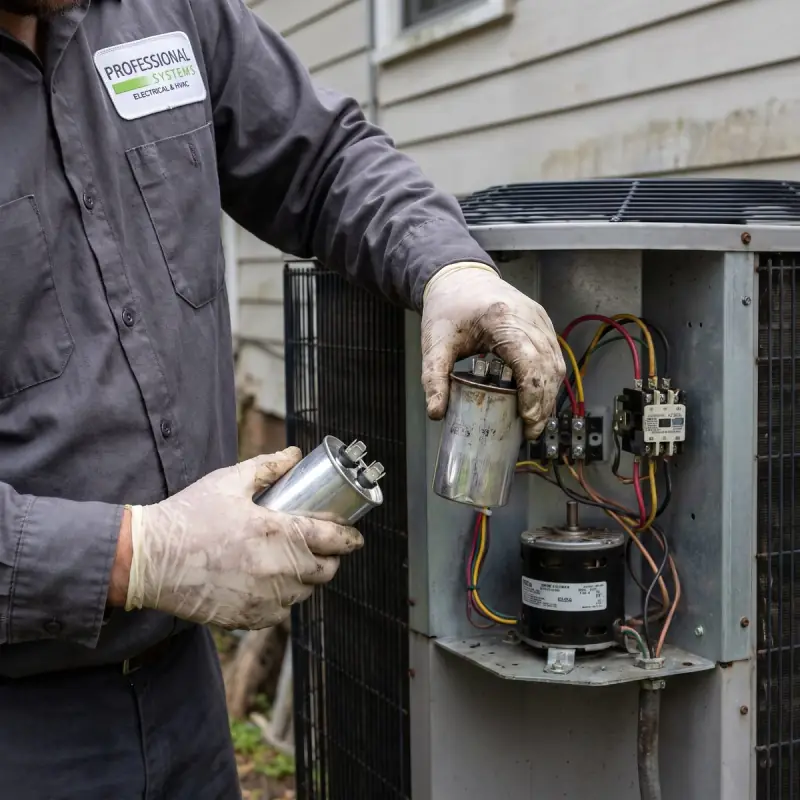
Confirm the thermostat is set to cool, the fan to auto, and the set point below the room temperature. If it is a battery thermostat, replace the batteries. Walk outside and look at the outdoor unit: is the fan spinning? Is it humming without spinning? Is it silent? Check the breaker for the condenser once, and look at the grey disconnect box on the wall beside the unit to make sure the pull-out is seated. Lawn crews and curious children pull them.
If the outdoor unit is humming and not starting, turn the system off at the thermostat and leave it off. A compressor trying to start against a failed capacitor overheats, and a few more hours of that turns a hundred-dollar part into a compressor. If the air is hot rather than warm on a heat pump, turn the system off too. Then call, and tell us which of these you found.
If the thermostat screen is blank, the problem is usually electrical, and that is a job for a technician. A Spanish Fort upstairs thermostat that went blank in April needed a new transformer and contactor, both replaced the same day.
Mode, wiring, transformer and the low-voltage signal to the outdoor unit. A failed thermostat or a chewed wire is a quick fix.
Tested under load at the outdoor unit. These three parts ride on every truck and are replaced the same visit.
Amp draw and winding test. A locked or shorted compressor is the expensive case, and it comes with an honest repair-or-replace conversation.
On a heat pump, the valve and its solenoid are checked. A stuck valve is sometimes freed; a failed one is replaced under warranty when the unit qualifies.
Gauges on, and an electronic leak search if the charge is gone. The leak is repaired, the system evacuated and charged to spec.
Diagnosis first, then the written price, then the work. If the system is old, the replacement number is on the same sheet.
When the call is hot air rather than a house that will not catch up, the ticket usually closes on a control or a part at the outdoor unit, not on refrigerant. Of the fifty-five no-cool jobs we ran between February and mid-August 2026, thirteen were put right without a new part: a thermostat set wrong or out of batteries, a tripped breaker, a pulled disconnect, a float switch that had done its job. Eleven more were capacitors and two were contactors, the two parts that leave the inside blower running while the outdoor unit sits silent, and that is exactly what hot air at the vents feels like.
The phone calls tell the same story. One April caller had cold refrigerant lines outside and hot air inside and could not get the heat to shut off, which is a heat pump stuck in heating or a thermostat calling for it, not a dead system. Heat pumps are the special case on this page: the reversing valve that sends a heat pump the wrong way in July has a cousin, the defrost control board, that leaves it without heat in January, and this year we replaced defrost boards in January and again in May.
Turn the system off if the outdoor unit is humming, then call. Same-day on most weekdays in season across Mobile and Baldwin counties.
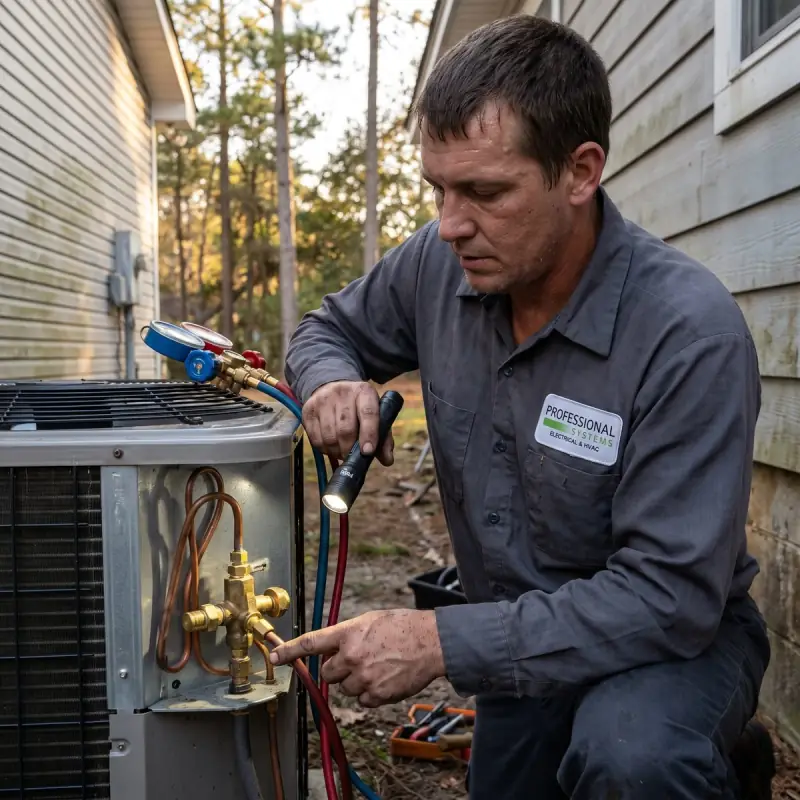
A heat pump is an air conditioner that can run backwards, and the part that decides the direction is the reversing valve. When the valve sticks, loses its solenoid coil or receives the wrong signal from the thermostat, the system heats the house in July. The giveaway is air that is genuinely hot at the vent, not merely warm, with the outdoor unit running.
Thermostat wiring matters here too: a heat pump thermostat energizes the reversing valve in one mode, and a thermostat wired for the wrong equipment type will run the system backwards all season. We see it after do-it-yourself smart-thermostat installs more than anywhere else. Our thermostat page covers the common wiring mistakes.
Carrier, Trane, Lennox, Rheem, Goodman and the rest are all repaired, and reversing valves on qualifying units are replaced under the manufacturer's parts warranty.
"We are more than satisfied with the responsiveness and thorough job done by Professional Systems. Mark Graham, the technician, was amazing! We arrived and found our air conditioner was only putting out hot air."
— Marsetta R., Google review"I called on a Friday evening due to my AC not cooling and in less than an hour a technician was at my home. Very professional and knowledgeable. I had to have my air handler replaced and on Monday I received my quote and on Wednesday they were there to replace it."
— Paula D., Google review"Jerry and his team are prompt, trustworthy, and easy to communicate with. Jerry went out of his way to make sure I was taken care of very quickly! 10/10 recommend for any HVAC needs."
— Paul K., Google reviewEither the thermostat is in the wrong mode, the outdoor unit is not running, a heat pump's reversing valve is stuck in heating, or the refrigerant has leaked out. Check the thermostat and look at the outdoor unit first; those two account for most cases.
Almost always a failed capacitor, sometimes a seized fan motor. Turn the system off at the thermostat so the compressor stops trying to start, and call. It is a same-visit repair on most units.
Check the condenser breaker once and the pull-out disconnect beside the unit. If both are fine, the contactor, the low-voltage wiring or the thermostat is not telling the unit to run, and a technician finds which.
It can be either. A reversing valve stuck or failed is a unit problem; a thermostat wired for the wrong equipment type is a wiring problem. Both are fixed on the same visit; the diagnosis tells us which, and the price is written down before the work.
If the outdoor unit is humming without starting, no: turn it off. If the thermostat is simply in the wrong mode, fix the setting. If the air is warm and the outdoor unit runs normally, running it does little harm but does little good; a fan in the window is a better use of the electricity.
A capacitor, a contactor or a thermostat is at the low end; a reversing valve or a compressor is at the high end. The technician gives you the number in writing after the diagnosis, and shows you the replacement price beside it when the system's age makes that the honest conversation. On a weekday, a technician's visit is a flat $175 diagnostic fee that covers the first hour at your home or business; parts and anything beyond that are priced in writing before we do them.
Something we didn't cover? See our full FAQ page or call (251) 680-7500.
Diagnosis on site, every brand, the repair price in writing before the work.
AC RepairWiring, modes and the thermostat mistakes that run a heat pump backwards.
ThermostatsLicensed technicians, same-day on most weekdays in season, the price in writing before the work.
Call (251) 680-7500 Request a Quote