
Storm surge on Mobile Bay, Dog River, Fowl River and the Gulf puts condensers, crawlspace air handlers and ductwork under water. Some of it can be saved. Most of what sat in saltwater cannot, and the honest answer up front saves you a second replacement in August. Licensed HVAC technicians in Mobile and Baldwin County, with elevated stands so it does not happen twice.
Call (251) 680-7500 Request Storm ServiceA condenser is a sealed refrigerant system with an electrical compartment, a fan motor and a compressor whose terminals sit a few inches off the base. Water that reaches the compressor terminals, the contactor and the capacitor leaves silt and salt behind that keep corroding after everything dries. The fan motor bearings are done. If water got into the refrigerant circuit through a damaged line, the compressor oil is contaminated and the compressor follows. Manufacturers treat a submerged unit as a replacement, and so does the warranty.
Saltwater makes it certain. A unit that stood in bay water for an afternoon can be dried, started and run, and it will fail in a few months, usually in the compressor, usually in the heat. That is why we test and photograph, tell you where the water reached on each component, and put the repair price and the replacement price side by side rather than guess with your money.
If you see downed lines, smell burning or hear buzzing, stay away, keep people and pets clear, and call 911 or the power company first. Then call us.
Call (251) 680-7500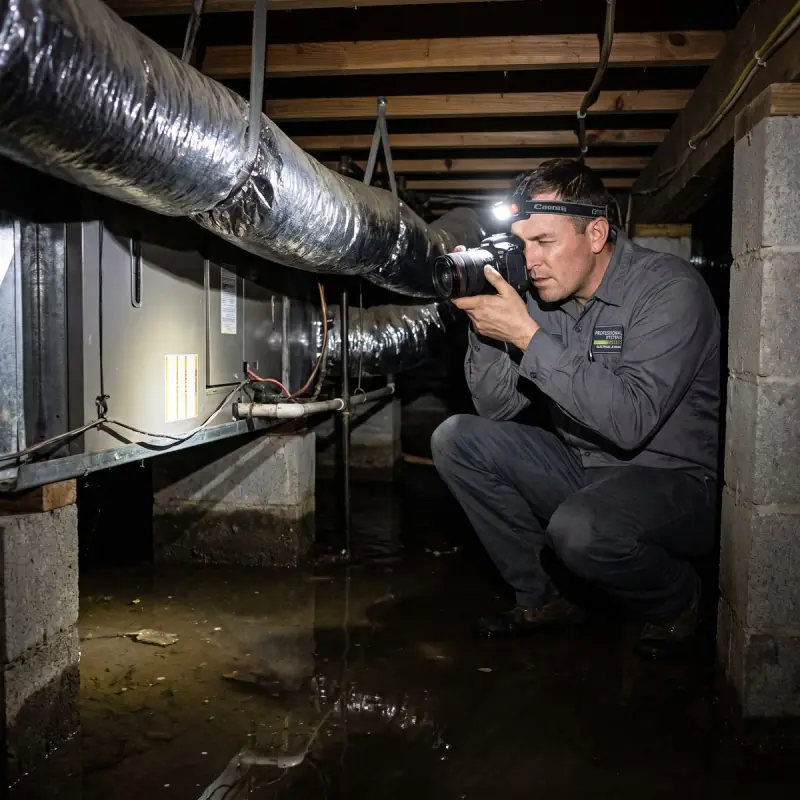
Water to the base pan only: clean, test and usually keep. Water above the compressor terminals or into the electrical compartment: replace. Saltwater to any electrical part: replace.
Blower motor, control board, wiring and the insulation lining are ruined by submersion, and the cabinet holds mud and spores afterward. Replaced, and relocated higher where the house allows.
A flooded furnace is a replacement under every manufacturer's guidance and the gas code: the gas valve, burners and controls cannot be trusted after submersion.
Flex duct and fiberglass duct board that got wet are replaced; they cannot be cleaned. Sheet-metal trunk lines can be cleaned, sanitized and re-insulated. Crawlspace ducts that floated and separated are rerun.
A line set that stayed sealed is fine. One that was broken by a shifted unit or debris let water in, and the system is flushed or re-piped before a new compressor sees it.
The outdoor disconnect, the whip, the condensate pump and any flooded thermostat or zone control are replaced with the equipment.
Before anything is moved: the condenser, the air handler, the ducts and the line on the wall or the piers. Your claim needs it.
Each component tested and classified: keep, repair or replace, with the reason. You get the repair and replacement numbers side by side in writing.
Flooded equipment and ductwork removed, the space dried and sanitized, coordinated with your remediation crew so nothing new goes in wet.
The new condenser on an elevated stand with tie-downs; the air handler relocated to the attic or a raised closet where the house allows; ducts rerun above the water.
Charge weighed in, airflow set, the system run and checked, and an itemized invoice with photos for the adjuster.
We photograph the waterline, test every component and give you repair and replacement prices side by side, in writing.
On the bay and the rivers the new condenser goes on a galvanized or aluminum elevated stand set above the base flood elevation for the lot, anchored and strapped for wind. For raised homes we build a platform under the house or on a side deck; for slab homes in the surge zone a four-foot stand is common on the Eastern Shore and the island. The line set, the disconnect and the whip are rerouted to match.
Crawlspace air handlers are the equipment that floods first and is hardest to dry. Where the attic or a hall closet can take it, we relocate the air handler up and rerun the trunk lines, which also ends the yearly crawlspace moisture problems. It is more work on the replacement day and it is the reason you do not see us again after the next storm.
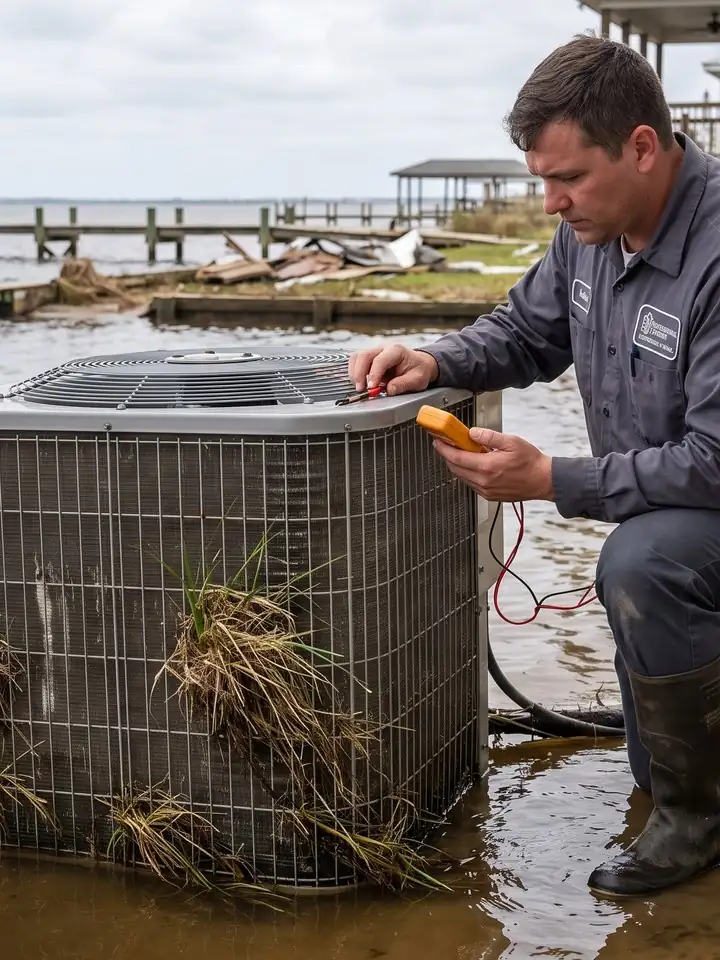
Not every flooded system is a loss. A condenser that stood in two inches of fresh rainwater, below the compressor terminals, is cleaned, tested and put back into service more often than not. An air handler in a closet that took water on the floor but not into the blower compartment can sometimes be saved with a new board and a dry-out. We tell you which case you are in after the test, not before.
Flood damage is usually excluded from a standard homeowners policy and covered by a separate flood policy, while wind-driven rain is treated differently; we cannot tell you what your policy pays. What we can do is make the HVAC part of the claim complete: photos of the waterline, the test results, and an itemized replacement estimate your adjuster can read.
"A storm came through and messed up the electric in our house. We got a quote quickly and they got us up and running fast! The guys did a great job and even helped us save money."
— Devan H., Google review"Came home late afternoon to find my power off. I called after hours and Robby was over in 15 min. It was a bad circuit breaker. From the time I saw I had no power til the time I had power back on was around 30 min. Amazing. Super nice guys as well."
— Gary S., Google review"They diagnosed a power issue that other companies weren't able to. The technician was extremely knowledgeable and professional, and explained everything very well. Also, I called them at 8 at night and got a human being on the phone!"
— Laura B., Google reviewIf the water stayed below the compressor terminals and the electrical compartment, and it was fresh water, often yes after cleaning and testing. If the water reached the electrical parts, or it was saltwater, it is a replacement. We test and tell you which.
It corrodes the compressor terminals, the contactor, the fan motor and every connection, and the corrosion keeps going after the unit dries. Units that ran fine after a bay flood commonly fail within months. We treat saltwater exposure to any electrical part as a replacement.
The blower, board and insulation are ruined and the cabinet holds mud. It is replaced, and if the house allows we relocate it to the attic or a raised closet and rerun the ducts above the waterline.
Flex duct and fiberglass duct board, yes; they cannot be cleaned once wet. Sheet-metal trunk lines can be cleaned, sanitized and re-insulated.
On the bay, the rivers, the island and anywhere the lot flooded, yes. An elevated stand set above the base flood elevation and strapped for wind is the one upgrade that keeps the replacement out of the next storm.
Usually only under a flood policy, and every policy differs; we cannot promise coverage. We photograph the waterline, document the test results and write an itemized estimate so the claim is complete.
Rinsing the coil is fine and we do it as part of the test. Running it is the gamble: if water reached the contactor, the capacitor or the compressor terminals, the first start can weld the contactor or finish the compressor. Have it tested first; it takes less than an hour.
A condenser on a new elevated stand with the lines rerouted is usually one day. Relocating a crawlspace air handler to the attic and rerunning the ducts is two to three days, scheduled after the house is dry enough to work in.
Something we didn't cover? See our full FAQ page or call (251) 680-7500.
Electrical, HVAC and generator repair after a storm, from one Mobile crew.
Storm damage hubWind and debris damage: tipped units, crushed fins, broken lines and surge-fried boards.
Storm AC repairLicensed HVAC technicians test flooded condensers, air handlers and ducts across Mobile and Baldwin County, replace what the water took, and set it above the next flood line.
Call (251) 680-7500 Request Storm Service