
A breaker that trips is doing its job: something on that circuit asked for more current than the wire can safely carry, or current went somewhere it should not. The question is which, and whether it is the circuit, an appliance, or the breaker itself that has failed. Here is how to tell, what is safe to try in a Mobile home, and when a licensed electrician needs to open the panel.
Call (251) 680-7500 Request a QuoteEvery tripped breaker has one of five causes. Which one it is decides whether you can fix it by moving a space heater, or whether the panel needs to be opened by someone licensed to do it. The four reasons a breaker trips, in the order we find them:
A breaker that will not reset at all is a different problem from one that trips now and then. On a Sunday in May, a breaker in a Fairhope home tripped and would not reset, leaving part of the house dark with guests staying over. A person answered and put the homeowner straight through to the electrician on duty, who was out that day.
Call (251) 680-7500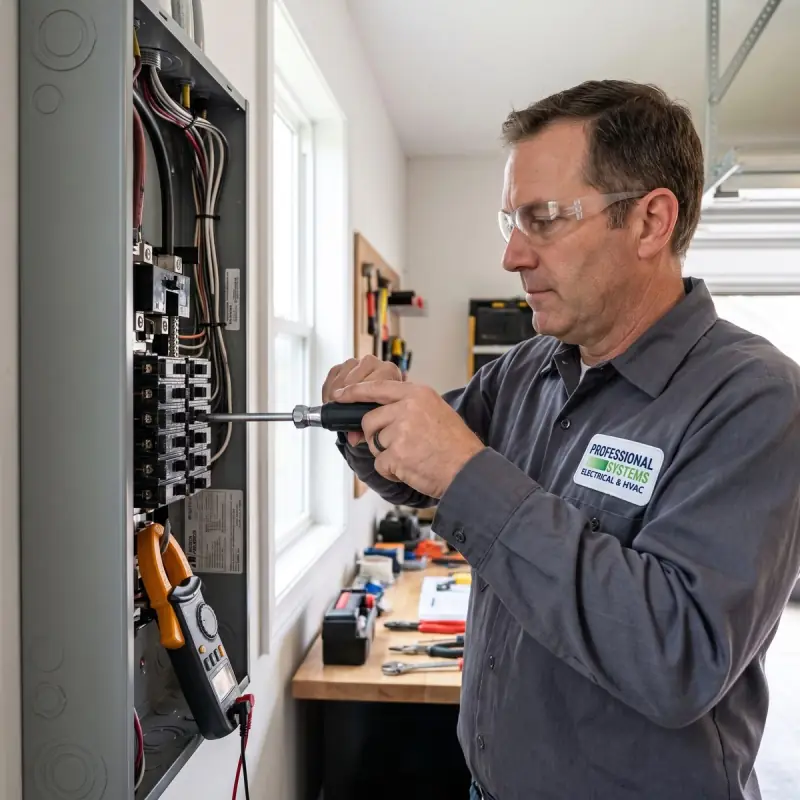
Unplug everything on the circuit, then reset the breaker once by pushing it fully off and then on. If it holds, plug things back in one at a time; the one that trips it is the problem, and if that is a single appliance, the circuit may be fine. If it trips with nothing plugged in, the fault is in the wiring, a device or the breaker, and the panel needs to be opened. Press TEST and RESET on any GFCI on the circuit, including the ones in the garage and outside that feed other outlets.
Stop resetting it after the second try. A breaker reset repeatedly against a short circuit heats the wiring behind the walls. If the breaker is warm, smells, buzzes or will not reset at all, leave it off and call. If it is the main breaker tripping, call; that is the whole service and it is not a do-it-yourself afternoon.
If anything crackles, smokes or smells when you reset it, leave it off. One night in May, the power to a Spring Hill laundry room cut out. When the homeowner reset the breaker he heard crackling, then saw smoke and charring near the washer and dryer. He shut it off and called us in the morning, and that week our electrician tracked down the problem at the laundry-room breaker and replaced an outdoor receptacle while he was there.
What is on it, what it draws, and whether the circuit was ever meant to carry it. The answer is often a dedicated circuit for the appliance that keeps tripping the kitchen.
Insulation tested, devices opened, the fault isolated to the device or the run. Shorts behind walls are found with a tracer, not by guessing.
Tested under load and compared to its rating. A breaker that trips low, or will not reset, is replaced with the correct type for the panel.
Moisture, damaged cords, shared neutrals and incompatible equipment are the usual reasons. Corrected so the protection stays in place without the nuisance.
Compressor start-up draw measured and compared to the rating. A weak capacitor, a hard-start problem or a breaker at the end of its life, found under one roof because we hold both licenses.
Loose lugs, heat damage, double-tapped breakers and the hazard-brand panels that trip or fail to trip for their own reasons. Repaired or quoted for replacement, in writing.
Leave it off and call. Licensed electricians across Mobile and Baldwin counties, same-day on most weekdays, the price in writing before the work.
The breaker that trips most often in a Mobile summer is the condenser's. A compressor draws several times its running current for a fraction of a second on start-up, and as capacitors weaken and compressors age that surge grows until a breaker that held for ten years starts tripping on hot afternoons. Sometimes the breaker is simply worn out. Sometimes the capacitor is failing and the compressor is struggling to start. Sometimes the compressor itself is on its way out and the breaker is the first to say so.
Because we hold both licenses, one visit measures the start-up draw, tests the capacitor and the contactor, checks the breaker and the wiring, and tells you which it is, with the price written down. A hard-start kit, a capacitor or a breaker is a small repair; a compressor is a repair-or-replace conversation, and we have it honestly.
Air conditioners are not the only thing a failing breaker can take down. A Loxley home on a grinder pump cannot use its plumbing without power to the pump, so when the pump's breaker failed in July, we treated it as an emergency and replaced the breaker that same day.
"Came home late afternoon to find my power off. I called after hours and Robby was over in 15 min. It was a bad circuit breaker. From the time I saw I had no power til the time I had power back on was around 30 min. Amazing. Super nice guys as well."
— Gary S., Google review"They diagnosed a power issue that other companies weren't able to. The technician was extremely knowledgeable and professional, and explained everything very well. Also, I called them at 8 at night and got a human being on the phone!"
— Laura B., Google review"Professional Systems responded quickly, diagnosed an unusual problem and had me up and running in short order. They charged me less than I expected to pay and the whole process took less time than I anticipated."
— David A., Google reviewOnce, after unplugging what is on the circuit. If it trips again with nothing plugged in, or trips instantly, stop. Repeated resets against a short circuit heat the wiring in the walls, and a breaker that will not reset should be left off until an electrician looks.
Compressor start-up draws a large momentary current. A weakening capacitor, an aging compressor or a worn breaker turns a surge the breaker tolerated for years into one it trips on. We test all three on one visit because we hold both licenses.
Moisture is the usual reason, especially in outdoor, garage and bathroom locations after rain. A damaged cord, a failing appliance or an outlet downstream that got wet are next. GFCIs also wear out and start tripping on their own.
Yes. Breakers are mechanical and wear with every trip and every hot summer. One that trips below its rating or will not reset is replaced, with the correct type for the panel. Some older panel brands have breakers that fail the other way and do not trip at all; those panels are replaced.
The fault is in the wiring, a hard-wired device or the breaker itself. It needs the panel opened and the circuit tested, which is licensed work.
A worn breaker, a GFCI or a dedicated circuit for an overloaded kitchen is a small job; a short behind a wall or a panel problem is more. The electrician finds the cause and writes the price down before any work, and most of these are same-visit repairs. On a weekday, a technician's visit is a flat $175 diagnostic fee that covers the first hour at your home or business; parts and anything beyond that are priced in writing before we do them. Nights, weekends and holidays, the emergency fee is $360 and covers the first two hours of work; if the job will take longer, the technician gives you the price before going further. You hear the fee on the phone before anyone heads your way.
Something we didn't cover? See our full FAQ page or call (251) 680-7500.
Licensed electricians find the fault and price the fix in writing.
Electrical ServicesLicensed electricians, same-day on most weekdays, the cause found and the price in writing before the work.
Call (251) 680-7500 Request a Quote