The neighbors have power and you have half of it. Some rooms work, the dryer and the AC do not, a few lights are dim or too bright, and a breaker will not reset. After every outage in Mobile this is the call we get most, and the cause is usually one of five things. Here is what each one means, what you can check safely, and when to turn the main off and call.
Call (251) 680-7500 Request Storm ServiceYour house is fed by two hot legs and a neutral. Each leg carries 120 volts to roughly half the circuits in the panel, and the big appliances, the dryer, the range, the water heater and the air conditioner, use both legs together for 240. If a storm takes one leg out somewhere between the pole and your main breaker, every circuit on that leg goes dark and every 240-volt appliance either dies or limps. That is the classic half-dead house.
If the storm damaged the neutral instead, something stranger happens: the two halves of the house start sharing voltage unevenly. Lights on one side glow bright while the other side dims, bulbs flicker, and electronics start dying one by one. A lost neutral is the dangerous version of this problem, and it is the reason the first instruction on this page is to turn the main off when you see bright-and-dim lights.
If you see downed lines, smell burning or hear buzzing, stay away, keep people and pets clear, and call 911 or the power company first. Then call us.
Call (251) 680-7500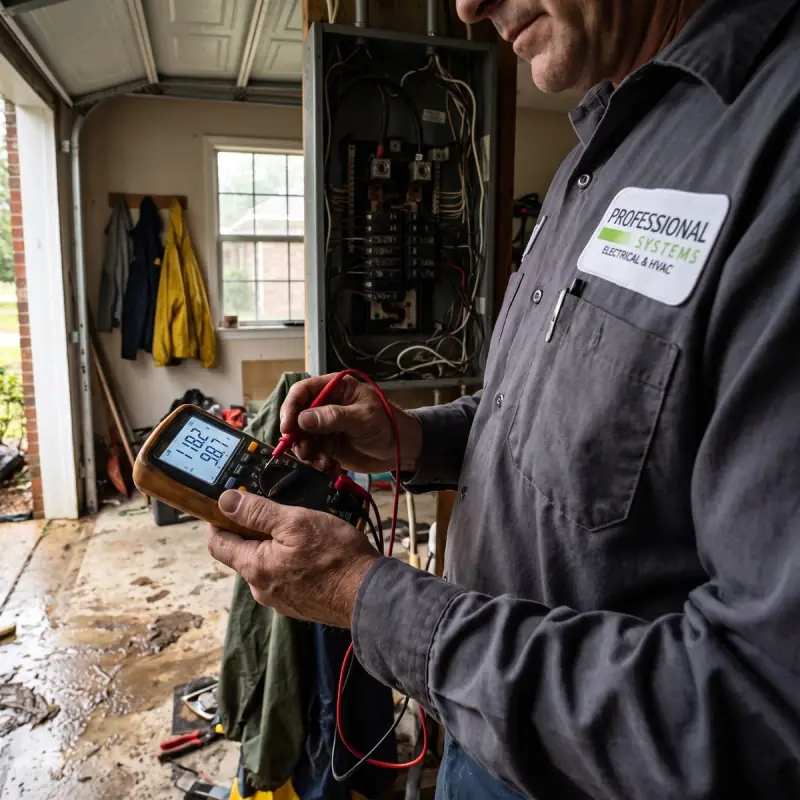
A tree on the service drop or a mast pulled by the wind breaks or loosens one of the two hot conductors. If the break is on the utility's side, it is their repair; if it is in your mast, weatherhead, service cable or meter base, a licensed electrician repairs it before the utility will touch it.
The neutral is the wire the two legs share. Pulled loose at the weatherhead, corroded in the meter base or burnt at the main lug, it sends uneven voltage through the house: bright and dim lights, flickering, dead electronics. Main off, call now.
Breakers that tripped hard during the storm, or that took water, sometimes will not reset, or reset and will not hold. The main breaker itself can fail the same way. Replaced, not forced.
The flicker as the grid comes back is a surge, and it takes out the boards in the air handler, the water heater, the range, the garage door opener and the GFCIs. Each dead device looks like a dead circuit until it is tested.
The one you can fix yourself. One GFCI in the garage, a bathroom, the kitchen or outside often feeds a chain of outlets, and a storm trips it. Press reset on every GFCI you can find before you call.
Rain blown into a cracked weatherhead runs down the service cable into the panel and shorts a leg or a group of breakers. Looks like a tripped breaker, is not.
A bent mast, a weatherhead hanging open, or a meter base pulled from the wall explains the problem on its own. Do not touch any of it.
If the dryer, range or AC is dead or weak and the dead rooms are scattered through the house, one leg is gone. If lights are bright in some rooms and dim in others, stop here and turn the main off.
Garage, bathrooms, kitchen, outdoor outlets. A tripped GFCI is the most common cause of one dead run of outlets after a storm.
A tripped breaker sits between on and off. Push it fully off, then on, once. If it trips again or will not move, leave it alone.
If the neighbors are out too, report it to the utility. If the street has power and the damage is at your mast or meter, or anything inside is wrong, call us; we coordinate with the utility when the fault is on their side.
A lost neutral destroys electronics by the minute. We find where it opened and fix it the same day.
With the neutral gone, the house becomes one long series circuit across 240 volts, and the voltage splits according to whatever is turned on. A bedroom with a lamp on may see 180 volts while the kitchen sees 60. Televisions, computers, the refrigerator board, the microwave and the furnace control board die first, and the burn marks we find later are usually at the neutral lug, the meter base or the weatherhead.
Turning the main breaker off stops the damage immediately. From there a licensed electrician measures each leg at the lugs under load, finds where the neutral opened, repairs it if it is on your side of the meter, and gets the utility out if it is on theirs. We also test what the open neutral already killed, so the list for your insurer is complete, and we install whole-house surge protection at the panel so the next restoration does not take the replacements out too.
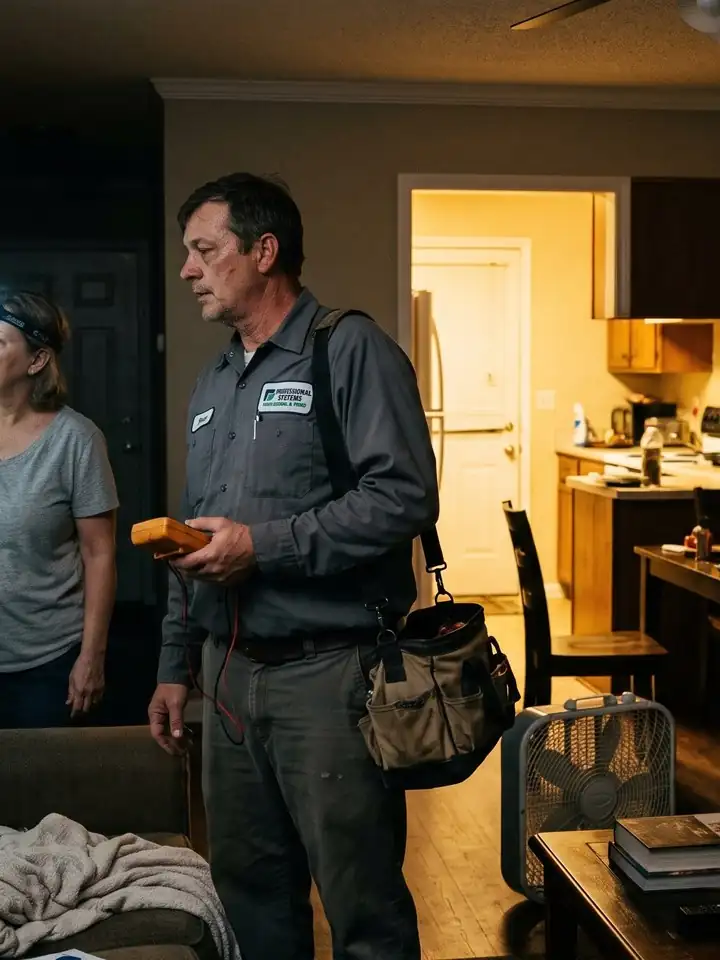
Voltage on both legs and the neutral at the main lugs, under load, which tells us in a minute whether the fault is at the drop, in the mast and meter, or in the panel. If it is yours, we repair it on the spot: service cable, meter base, weatherhead, main breaker, branch breakers, a lug that burned. If it is the utility's, we tell you exactly what to report and stay on it until the crew comes.
Then we test the circuits and equipment that went dark, replace what the surge took, and give you a written, itemized invoice with photos for your claim. No hourly rate and no after-hours surcharge; the price is written before the work starts. After a storm we run these calls in the order they come in, with existing customers on the priority list.
"A storm came through and messed up the electric in our house. We got a quote quickly and they got us up and running fast! The guys did a great job and even helped us save money."
— Devan H., Google review"Came home late afternoon to find my power off. I called after hours and Robby was over in 15 min. It was a bad circuit breaker. From the time I saw I had no power til the time I had power back on was around 30 min. Amazing. Super nice guys as well."
— Gary S., Google review"They diagnosed a power issue that other companies weren't able to. The technician was extremely knowledgeable and professional, and explained everything very well. Also, I called them at 8 at night and got a human being on the phone!"
— Laura B., Google reviewBecause the problem is between the pole and your panel: a broken leg or neutral at the service drop, a damaged mast or meter base, or a failed main breaker. The utility's crews restore the line on the street; what hangs on your house is repaired by a licensed electrician, and the utility reconnects to it once it is fixed and inspected.
Reset every GFCI, check the breakers once, and look at the mast and meter from the yard. If the dead rooms are scattered and the 240-volt appliances are weak or dead, a leg is out; call us. If any lights are bright and others dim, turn the main off first.
Yes. Bright-and-dim lights are the signature of a lost neutral, and it destroys electronics and can start a fire at the connection that failed. Turn the main breaker off and call. It is a same-day repair.
Push it fully off and then on once. If it trips again or will not move, stop. A breaker that will not hold is protecting you from a fault, or it is damaged and needs to be replaced. Forcing it is how panels get scorched.
Many homeowner policies include some coverage for sudden electrical damage, but every policy differs and we cannot promise what yours pays. We document the cause, list the damaged equipment and provide an itemized estimate so the claim is complete.
If the whole street is dark, the utility. If the street has power and you do not, or only half of your house does, call us; we find the fault and either repair it or get the utility out for their side.
Something we didn't cover? See our full FAQ page or call (251) 680-7500.
Everything we repair after a storm, electrical and HVAC.
Storm damage hubThe repair the utility needs before it reconnects your house.
Mast repairRepairs, panels and wiring from Mobile's electrical division.
Electrical servicesLicensed electricians test the service, find the dropped leg or lost neutral, repair what is yours and coordinate what is the utility's, same day across Mobile and Baldwin County.
Call (251) 680-7500 Request Storm Service