
A condenser sitting loose on a plastic pad is the first thing a hurricane moves. Strapped to an anchored pad it stays put; set on an elevated stand above the flood line it stays dry. It is a pre-season service most Mobile homeowners do not know exists, it is the natural add-on to any storm replacement, and it is a short visit from our HVAC team in Mobile and Baldwin County.
Call (251) 680-7500 Request Storm ServiceAn outdoor unit weighs 150 to 300 pounds and presents a flat side to the wind. In a hurricane it slides, tips, and rolls off the pad, which kinks the refrigerant lines, tears the electrical whip and often bends the fan. Florida has required mechanical equipment to be anchored for wind for years, and the building codes adopted along the Alabama coast carry the same requirement for new installations: equipment is anchored to resist the design wind load for the site. Most older installs in Mobile were never strapped at all.
Water is the second problem. On the bay, the rivers, the island and the Eastern Shore, surge reaches units that wind never would. A condenser that sits in saltwater for an afternoon is a replacement; one on a stand two feet above the base flood elevation is still running the next day.
Call (251) 680-7500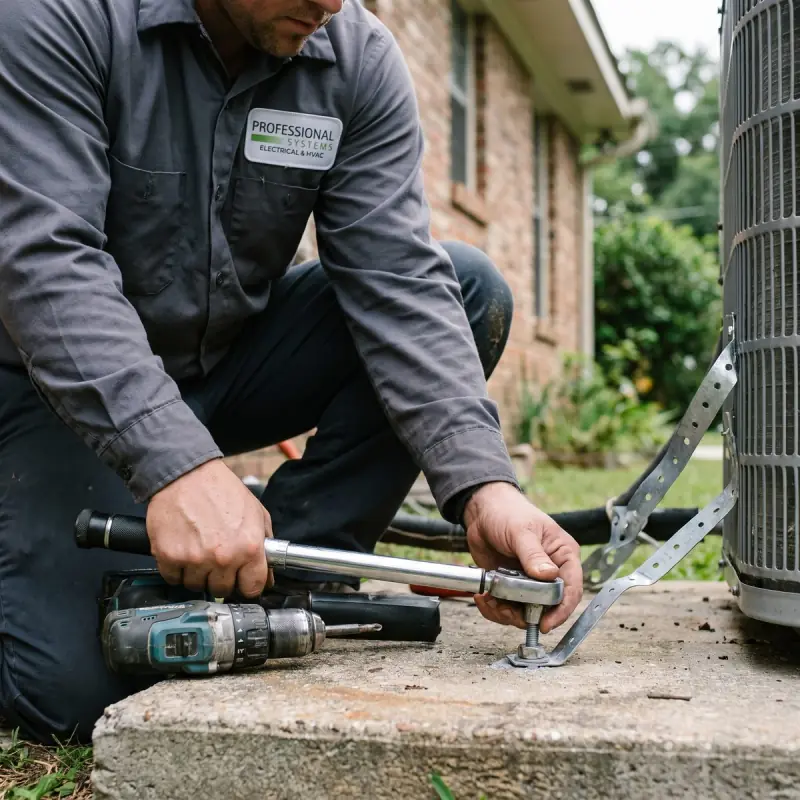
Galvanized or stainless straps and brackets fastened to the unit's base rail and anchored into the pad with wedge or epoxy anchors, rated for the wind zone. The standard upgrade for an existing unit on a solid pad.
A plastic or lightweight composite pad has nothing to anchor to. We set a poured concrete pad with cast-in anchor brackets, or a heavy precast pad with drilled anchors, and strap the unit to it.
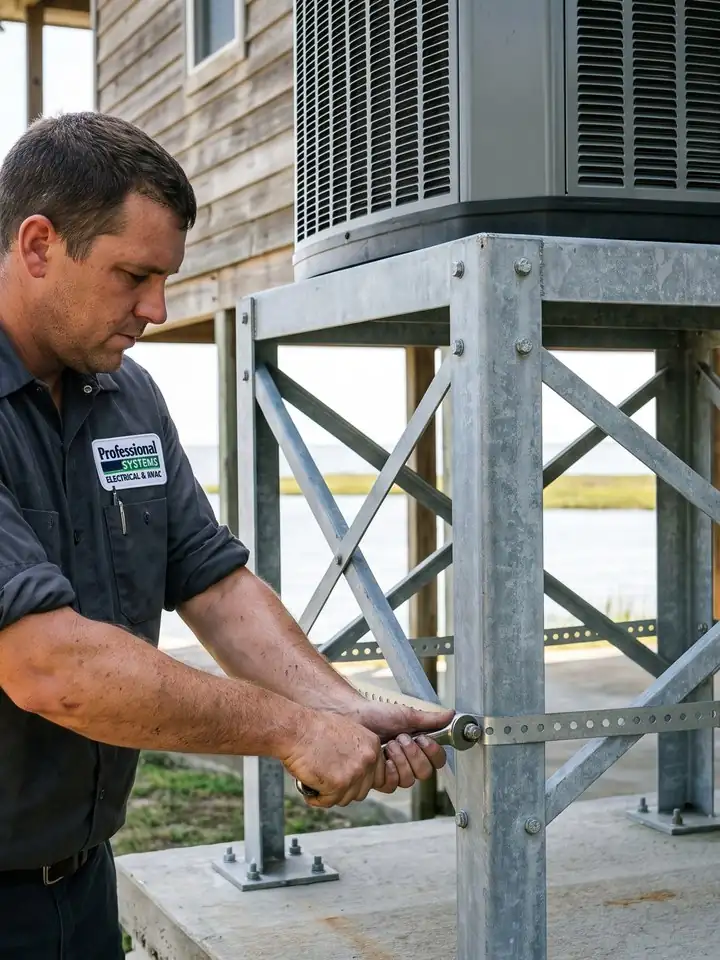
Galvanized or aluminum stands from 18 inches to 4 feet, cross-braced, anchored to a footing, with the unit strapped on top. The flood-zone answer for the bay, the rivers and the coast.
A framed platform under or beside a raised house, or a reinforced deck mount, with the line set and disconnect rerouted to match.
Ductless outdoor units moved off the ground onto rated wall brackets, above surge height and out of the debris.
Elevating the unit means re-routing the refrigerant lines and the electrical whip and raising the disconnect, which we do as part of the job so nothing is left hanging in the water.
Where the condenser sits, what it sits on, and whether the lot floods. A photo helps us quote it.
Strap kit, anchored pad or elevated stand, with the line set and electrical work included. No surprises.
Most strap-and-anchor jobs take an hour or two; an elevated stand with rerouted lines is a half day. The system is leak-checked and run afterward.
Photos for your records and your insurer, which some carriers ask for on coastal policies.
A strap kit on an anchored pad is an hour's visit; an elevated stand is a half day. Both come with a written price first.
Every storm replacement we do on the Gulf Coast gets this conversation, because the stand, the pad and the straps cost least when the old unit is already off and the line set is already open. The same is true of any new installation: a new condenser on an anchored, elevated base is a one-time upgrade that protects a system you just paid for.
If the unit is staying, strapping it is still the cheapest storm preparation on the house. It goes on the spring tune-up visit for our maintenance-plan customers, and it takes an hour.
Dauphin Island, Bayou La Batre, Coden, Theodore and the Dog River and Fowl River neighborhoods on the Mobile side; Daphne, Spanish Fort, Fairhope, Point Clear, Gulf Shores and Orange Beach across the bay. If your lot is in a mapped flood zone, the elevation of the new stand follows the base flood elevation for the parcel, and we coordinate it with the permit where one is required so the inspection goes through the first time.
Away from the water, wind is the issue, and a strap kit on an anchored pad handles it. Either way, you get a written price before the work and photos after it.
"A storm came through and messed up the electric in our house. We got a quote quickly and they got us up and running fast! The guys did a great job and even helped us save money."
— Devan H., Google review"Came home late afternoon to find my power off. I called after hours and Robby was over in 15 min. It was a bad circuit breaker. From the time I saw I had no power til the time I had power back on was around 30 min. Amazing. Super nice guys as well."
— Gary S., Google review"They diagnosed a power issue that other companies weren't able to. The technician was extremely knowledgeable and professional, and explained everything very well. Also, I called them at 8 at night and got a human being on the phone!"
— Laura B., Google reviewAn unstrapped condenser moves in hurricane winds, and a moved condenser means kinked lines, a torn whip and often a bent fan. Codes along the coast require new equipment to be anchored for wind; most older installations never were. A strap kit is an hour's work.
Not usefully; a plastic pad has nothing to anchor to and blows away with the unit. We set an anchored concrete or heavy precast pad and strap the unit to that.
Above the base flood elevation for the lot, plus a margin. On the bay and the island that is commonly two to four feet; inland lots that pond in heavy rain usually need 18 inches. We check the flood map for the parcel.
No, as long as the line set is re-run properly and the stand is level and braced. We leak-check and run the system after the move.
Some coastal carriers ask about it on wind-mitigation questionnaires. We cannot speak for your policy; we provide photos of the installed straps and anchors for your file.
Yes, and it is the cheapest time to do it, because the old unit is already off and the lines are already open.
Yes. They are lighter than a central condenser and move more easily. A rated wall bracket gets the unit off the ground, above surge height, and anchored to the structure.
Tie-downs cover the outdoor unit. If the air handler is in a crawlspace that floods, relocating it and rerunning the ducts is a separate job, and we quote it alongside the stand when the lot calls for both.
Something we didn't cover? See our full FAQ page or call (251) 680-7500.
Everything we repair after a storm, electrical and HVAC.
Storm damage hubWhat happens to a unit that was not elevated, and how we replace it higher.
Flooded HVACHurricane tie-down kits, anchored pads and elevated stands for outdoor AC units across Mobile and Baldwin County, installed by licensed HVAC technicians.
Call (251) 680-7500 Request Storm Service